
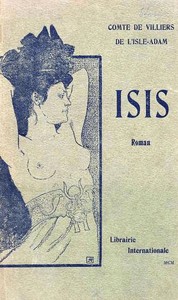
Isis: Roman by comte de Auguste Villiers de L'Isle-Adam
Let's set the scene: Ancient Rome, but not the one from gladiator movies. Villiers paints a Rome of hushed libraries, private gardens at dusk, and salons where people debate the meaning of existence. This is the world of Tullia Fabriana.
The Story
Tullia is young, recently widowed, and possesses a fortune that makes her independent. She also has a mind like a diamond—sharp, cold, and brilliant. Disgusted by the petty dramas and empty pleasures of Roman society, she embarks on a solitary project: to acquire absolute knowledge. She believes that by mastering all sciences, philosophies, and occult arts, she can rise above the human condition and achieve a divine, untouchable state. The plot follows her systematic, almost clinical, pursuit. She seeks out forgotten manuscripts, consults with mystics and scholars, and contemplates the fundamental questions of life, death, and consciousness. There's no villain chasing her; the antagonist is the limits of mortality itself. The story is a slow, mesmerizing portrait of a soul trying to climb out of its own skin.
Why You Should Read It
First, Tullia is a fantastic character. She's not 'likable' in a traditional sense—she's arrogant and remote—but you can't look away. Her hunger is palpable. Villiers uses her to ask big questions: What is the point of knowledge if it doesn't bring happiness? Can we think our way to paradise? The writing is dense and poetic, full of gorgeous, gloomy atmosphere. It feels less like reading a novel and more like walking through a beautifully curated museum of ideas, each room darker than the last. It’s a mood piece, a vibe. You read it for the haunting imagery and the unsettling questions it leaves in your head.
Final Verdict
This is not a book for someone looking for a fast-paced Roman adventure. Think of it more as a philosophical gothic novel that happens to wear a toga. It's perfect for readers who love atmospheric, idea-driven stories—fans of early sci-fi like Mary Shelley's Frankenstein or the decadent, symbolic tales of Oscar Wilde will find a lot to love here. If you enjoy getting inside the head of a complex, ambitious character and don't mind a plot that moves at the speed of thought, give Isis a try. It's a short, strange, and unforgettable trip.
Legal analysis indicates this work is in the public domain. You can copy, modify, and distribute it freely.
Kimberly Harris
3 months agoThe clarity of the concluding remarks is very professional.
Michael Wilson
8 months agoComparing this to other titles in the same genre, the objective evaluation of the pros and cons is very refreshing. Well worth the time invested in reading it.
Patricia Lopez
2 years agoI started reading this with a critical mind, the visual layout and supporting data make the reading experience very smooth. I'm glad I chose this over the other alternatives.
Christopher Hernandez
7 months agoOne of the most comprehensive guides I've read this year.






William Davis
7 months agoI stumbled upon this title during my weekend research and the narrative arc keeps the reader engaged while delivering factual content. This should be on the reading list of every serious professional.