About 37 minutes
Remarks upon the proposed destruction of the tower of the Parish Church of St. John, Hampstead — Context and Discussion
Architecture
8,451 recorded words. 4 minutes difference from this book's estimate.
View Gutenberg source #62222
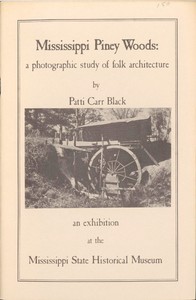
The source record for Mississippi Piney Woods: A Photographic Study of Folk Architecture — Text and Context measures this digital text at 7,518 words, 33 min estimated reading time, and 1 detected text section.
The text analysis averages about 18.0 words per sentence, while the detected sections provide another way to judge how the source is divided.
Project Gutenberg metadata also associates the work with “Architecture, Domestic -- Mississippi -- Piney Woods,” connecting these edition facts with the source record’s subject description.
Explore this collection
These alternatives are selected using recorded categories and estimated reading time.
About 37 minutes
Architecture
8,451 recorded words. 4 minutes difference from this book's estimate.
View Gutenberg source #62222About 43 minutes
Architecture
9,819 recorded words. 10 minutes difference from this book's estimate.
View Gutenberg source #61922About 18 minutes
Architecture
3,982 recorded words. 15 minutes difference from this book's estimate.
View Gutenberg source #66942Search stored excerpts and compare books → Choose by your preferences →
Choices use stored catalog measurements. Estimates vary with reading speed. A shared category is a catalog label, not a claim that two books have the same argument or literary quality.
Search reads excerpt text stored with this catalog and links to its associated Gutenberg record. The connection is stored in the site database; this tool does not recheck that every excerpt is word-for-word identical to that external record. Excerpt search does not cover every chapter and does not verify historical publication dates.
Catalog snapshot checked: 2026-09-25. Coverage: 95 public books, 95 available source excerpts.
Read the complete public-domain text at its original source.
Read on Project GutenbergPatti Carr Black's Mississippi Piney Woods presents a photographic survey of folk architecture in the southeastern part of the state, focusing on structures often overlooked in favor of antebellum mansions. The book opens with a quotation from Eudora Welty's Losing Battles describing a dogtrot house, a form Black notes has been part of the Mississippi landscape since the early 19th century. The study, originally an exhibition at the Mississippi State Historical Museum, documents buildings that reveal the ingenuity of builders with limited materials and no formal training.
The catalog subjects list "Architecture, Domestic -- Mississippi -- Piney Woods; Vernacular architecture -- Mississippi -- Piney Woods; Barns -- Mississippi -- Piney Woods." While barns appear in the excerpts—such as the cow barn, mule barn, and tool shed on the Sullivan farm—the book's emphasis is broader. It covers houses, campgrounds, and churches, not just barns. The term "vernacular architecture" is accurate, but the excerpts show a strong focus on dogtrot houses and log cabins, with detailed descriptions of construction techniques like V-notching and square-hewn logs. The catalog does not mention campgrounds or churches, which are significant sections in the text.
The excerpts repeatedly trace how buildings were altered over generations. For example, the Sam Hosey house near Moss, Jasper County, was built before 1880 and moved around 1882, with a code for reassembling the pen still carved in the logs. Later additions included walling off porch sections for a newlywed son in 1905 and converting rear porches into a kitchen and bathroom in the 1970s. Similarly, Tom Sullivan's cabin, built 1810–1820, was expanded with a double-pen and shed rooms, with mud-and-stick chimneys replaced by brick in 1915. These details show that folk architecture is not static but adapts to family needs.
The book includes a section on campgrounds and churches, which are integral to Piney Woods folk architecture. The Salem Campground, on the Jackson-George County line, is described as the oldest extant campground in Mississippi, with meetings held annually since 1826 except during two years of the Civil War. The tabernacle, built of rough lumber with log posts, seats 300 on wooden benches over a pine straw floor. Surrounding cabins, still called "tents," have two rooms each. This section demonstrates that religious buildings were not permanent structures initially but evolved from temporary arbors to more substantial forms, reflecting community practices.
Readers should approach this book as a focused documentary record rather than a comprehensive architectural history. The photographs—though not reproduced in the text excerpts—are presumably central to the work. The detailed captions and descriptions reward attention to construction details and family histories. The book's value lies in its preservation of specific, localized knowledge about buildings that were rapidly disappearing even in the 1970s.
That rainy afternoon, the Piney Woods catalog kept me company, its photographs of dogtrot houses speaking of families who built with what the land gave, and I found myself thinking less about architecture than about light—how it fell through those porches, through chapel windows. Later, almost by accident, I opened Angels in Art — Key Ideas to Explore, and the same quiet light seemed to live there. One book simply handed me the other.
Save your reaction, strongest insight, and memorable passage.









