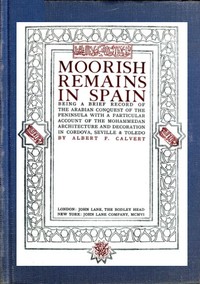
Albert F. Calvert's Moorish Remains in Spain (1906) opens with a dedication to King Alfonso XIII and a preface that frames the book as a companion to his earlier work on the Alhambra. The author's voice is that of an enthusiast turned scholar, moving from a confessed initial ignorance—he once thought the Alhambra was the sole Moorish monument—to a broader appreciation of Cordova, Seville, and Toledo. The preface establishes a narrative of sequential loss and survival: Toledo was adorned and lost before Cordova waned, and Seville rose only to be wrested away. This temporal layering sets the stage for a work that oscillates between historical sweep and close architectural observation.
A Voice Between Guidebook and History
Calvert's prose shifts between two registers: a brisk, almost breathless historical summary and a patient, inventory-like description of architectural features. In the preface, he writes of the Moors stamping their “virile and artistic personality upon Andalus,” a phrase that blends admiration with a period-specific racial essentialism. When describing the Alcazar of Seville, however, the tone becomes technical: he notes the “two pilasters, in their entire height, as well as the sculptured framing of the lower part, are of the Arab style,” and distinguishes between the horseshoe arch and later Egyptian-influenced square entrances. This alternation creates a rhythm where broad claims about Arabian influence give way to precise observations of stonework, inscriptions, and structural layering. The reader is never allowed to settle into a single mode; the text demands attention to both the grand narrative and the fragmentary detail.
Pace Shifts: From Conquest to Carved Stone
The pacing of the excerpts is uneven in a deliberate way. The preface compresses centuries into a few sentences: “Toledo had been adorned and lost; Cordova, which for centuries had commanded the admiration of Europe, had paled and waned beside the increasing splendour of Seville.” This rapid historical montage contrasts sharply with the later passage on the Alcazar, where Calvert lingers over the sequence of restorations—Pedro’s work, Juan II’s additions, Charles V’s Renaissance interventions, Isabella II’s 19th-century rescue. The effect is a kind of architectural palimpsest: the reader moves from the swift tide of conquest to the slow accretion of building campaigns. Calvert also uses temporal markers to create suspense: the Alcazar “has seldom been free from the hands of the restorers,” he writes, before enumerating each phase. This technique gives the prose a cumulative weight, as if the building itself accumulates history with each sentence.
Recurring Motifs: Decay, Restoration, and Incongruity
A persistent theme in the excerpts is the tension between preservation and loss. Calvert repeatedly notes what has been altered, removed, or obscured. In the Alcazar, he observes that later restorers “removed inscriptions and Mohammedan shields which filled the little spaces,” and he deplores the “weird incongruity of style and decoration” that results from successive interventions. The Alhambra, by contrast, is described as having suffered “periods of neglect that could be reckoned by scores of years.” This motif of decay versus restoration is not merely descriptive; it shapes the book’s argument that Moorish art survives in fragments, embedded within later structures. Calvert’s language of loss—the Alcazar “shrank to something like its original proportions” during neglect—gives the architecture a fragile, almost organic quality. The reader is reminded that what remains is not a pure original but a composite, a record of both creation and erasure.
Readers approaching Moorish Remains in Spain should attend to the way Calvert’s prose enacts the very layering he describes. The shifts in pace—from sweeping historical claims to minute architectural notation—mirror the palimpsest of Moorish, Gothic, and Renaissance elements he finds in the buildings. The book rewards a patient reading that follows these transitions, noticing how the author’s voice modulates between the confident narrator of conquest and the careful cataloguer of carved stone. The result is a work that, like its subject, is never quite one thing.
There’s something about Calvert’s old survey of Cordova and Toledo that stays with you—not the grand arches, but the quiet way he watches decay and restoration argue over the same walls. It reminded me of Ruskin’s gentler musings in The Poetry of Architecture Or, the Architecture of the Nations of Europe Considered in its Association with Natural Scenery and National Character — Themes and Context, where stone seems to breathe with the landscape around it. Both feel less like facts, more like a friend’s long pause.