About 98 minutes
Practical Farm Buildings: Plans and Suggestions — Themes and Context
Architecture
22,490 recorded words. 1 minutes difference from this book's estimate.
View Gutenberg source #65618
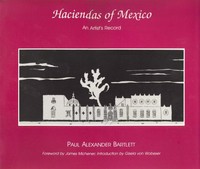
For The Haciendas of Mexico: An Artist's Record — Key Ideas to Explore, the stored edition analysis reports 22,127 words, 1 hr 37 min estimated reading time, and 4 detected text sections.
The text analysis averages about 15.0 words per sentence, while the detected sections provide another way to judge how the source is divided.
Project Gutenberg metadata also associates the work with “Bartlett, Paul Alexander, 1909-1990,” connecting these edition facts with the source record’s subject description.
Explore this collection
These alternatives are selected using recorded categories and estimated reading time.
About 98 minutes
Architecture
22,490 recorded words. 1 minutes difference from this book's estimate.
View Gutenberg source #65618About 92 minutes
Architecture
21,090 recorded words. 5 minutes difference from this book's estimate.
View Gutenberg source #18809About 92 minutes
Architecture
21,106 recorded words. 5 minutes difference from this book's estimate.
View Gutenberg source #58159Search stored excerpts and compare books → Choose by your preferences →
Choices use stored catalog measurements. Estimates vary with reading speed. A shared category is a catalog label, not a claim that two books have the same argument or literary quality.
Search reads excerpt text stored with this catalog and links to its associated Gutenberg record. The connection is stored in the site database; this tool does not recheck that every excerpt is word-for-word identical to that external record. Excerpt search does not cover every chapter and does not verify historical publication dates.
Catalog snapshot checked: 2026-09-25. Coverage: 95 public books, 95 available source excerpts.
Read the complete public-domain text at its original source.
Read on Project GutenbergPaul Alexander Bartlett opens his record not with a sweeping thesis but with a dedication to his son Steven, his compañero on many hacienda trips. This personal note sets the tone for a work that moves between the intimacy of travel and the rigor of documentation. Bartlett, an artist, spent years visiting and photographing hundreds of haciendas across Mexico, and his text reflects a dual attention: to the physical fabric of these estates—their architecture, furnishings, and layout—and to the human systems that built and maintained them. The book is neither a dry architectural catalog nor a romantic travelogue; it is a layered account that insists on seeing both the ormolu screen in the sala and the mahogany stocks in the punishment room.
Bartlett’s training as a visual artist shapes his prose. He notes details that a purely historical account might skip: the parotta table, the brass spittoons, the whatnot of oriental ivory carvings that cluttered a typical sala. These objects are not mere decoration; they are evidence of the hacienda’s reach into global trade networks and its owners’ aspirations to European refinement. At the same time, Bartlett’s eye for composition leads him to describe the one-room school located in the right wing of a residence at Hacienda de Mediñero—a small, telling detail that hints at the estate’s social structure. He does not linger on aesthetic judgment; instead, he presents what he saw, letting the juxtaposition of piano and pillory speak for itself.
The physical layout of the hacienda, as Bartlett describes it, was an architecture of control. The residence, the church, the school, the workshops, and the workers’ quarters formed a self-contained world. Bartlett’s photographs and text document how space was organized: the sala for receiving guests, the sacristy with its brass implements, the subterranean rooms where workers were chained. He notes that the most capable agronomists were the Jesuits, whose Instrucciónes forbade the whip and pillory—yet even on Jesuit estates, administrators chained mill workers. The buildings themselves, from the ornate church to the crude stocks, are treated as artifacts of a system that blended paternalism with exploitation.
Bartlett devotes considerable attention to the work that sustained the haciendas. He lists the cycles of planting, weeding, harvesting, and shucking, and notes the constant threat of rain or drought, pests and soil failure. The workers, he writes, were undernourished and small-boned, and their labor was often coerced. He directly addresses the question of slavery: He is a slave if he works in perpetual debt. Drawing on estimates of eight thousand haciendas in 1910, he calculates that black slavery numbered in the thousands, though he admits there is no accurate count. The text is careful to distinguish between forms of unfree labor—debt peonage, chattel slavery, and the encomienda system—while insisting on the continuity of coercion from the sixteenth century to the Revolution.
Bartlett observes that disharmony was common among the ethnic groups on the haciendas: negro, mulatto, mestizo, Creole, Zapotec, Méxica, Chichimeca, Yaqui. He does not flatten these distinctions into a single narrative of oppression; instead, he notes that each group’s mores were affected by Spanish customs and demands. The ethnic hierarchy was inscribed in the division of labor and in the physical space of the estate. At mining haciendas, workers grubbed for ore 1,000 feet below, while the hacendados lived like Carolingian kings. Bartlett’s account is unsparing: men, women, and children worked until they were ill or died, with no medical care. Yet he also records moments of cultural life—the London Broadway piano that brought Bach to the señora’s sala—suggesting that even within a brutal system, art found a place.
Bartlett’s record is best approached as a field notebook: it collects observations, photographs, and sketches without forcing them into a single argument. Readers should attend to the concrete details—the brass candle holder, the mahogany stocks, the one-room school—and consider how each object or space functioned within the hacienda’s economy of power. The book does not pretend to be a comprehensive history; it is an artist’s record, and its strength lies in what the artist’s eye notices and preserves.
Reading Bartlett’s haciendas, I kept thinking about how much of a life is carried in walls—the grandeur and the weight. That same quiet attentiveness lives in The great painters' gospel — Reading Companion, which traces old masters’ hands the way Bartlett traces stonework. Both feel like listening to someone who spent years looking carefully, and now shares what they saw, softly, without hurry.
Build a private reading journal entry for this title.









