
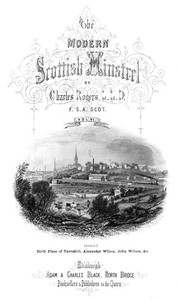
The Modern Scottish Minstrel, Volume 6. by Charles Rogers
Let's be clear: this isn't a novel. 'The Modern Scottish Minstrel, Volume 6' is the final piece of a six-volume anthology published in the 1850s. Its goal was to preserve and celebrate Scottish songwriting from the late 1700s onward. The book presents a wide range of poems and songs, from heartfelt ballads about exile and homeland to lighter, humorous verses. Each piece is presented with the author's name (when known) and sometimes a short note. The official editor listed is Charles Rogers, a respected historian and editor of the time.
The Story
There isn't a plot in the traditional sense. The 'story' here is twofold. First, it's the emotional journey of the poems themselves—a collective voice of Scotland during a period of great change. Second, and more intriguingly, is the story around the book. Charles Rogers oversaw the project and wrote the introductory material, but the preface hints that the actual work of finding, selecting, and compiling the hundreds of poems was done by another, unnamed person. Rogers credits this 'able compiler' but never names them. So, while you read beautiful verses by known poets, you're constantly aware of this silent, skilled curator whose identity has been lost to time.
Why You Should Read It
I picked this up for the poetry but stayed for the mystery. It changes how you read. You start seeing the collection not just as songs, but as a deliberate argument about what Scottish culture was. What did this anonymous compiler think was worth saving? The themes are timeless—longing, nature, resilience—and the language is rich without being impossible. But the real hook is feeling like you're part of a search. You're looking for the compiler's fingerprints in the selection, trying to guess their tastes and motives. It turns a historical artifact into something strangely personal and active.
Final Verdict
This is a niche pick, but a fascinating one. It's perfect for poetry lovers who enjoy historical context, or for readers curious about the 'making of' books and how credit gets assigned. If you want a fast-paced narrative, look elsewhere. But if you're the kind of person who reads the acknowledgements in a book and wonders about the untold stories behind it, this volume offers a unique, quiet thrill. You get a beautiful snapshot of Scottish verse and a lingering question that makes history feel alive.
This publication is available for unrestricted use. Enjoy reading and sharing without restrictions.
Patricia Martin
1 year agoComparing this to other titles in the same genre, the historical context mentioned in the early chapters is quite enlightening. If you want to master this topic, start right here.
Sandra Perez
1 year agoRead this on my tablet, looks great.
Aiden Scott
6 months agoI was skeptical at first, but it challenges the reader's perspective in an intellectual way. I learned so much from this.
Melissa Miller
1 year agoFrom the very first page, it challenges the reader's perspective in an intellectual way. Don't hesitate to start reading.
David Taylor
1 month agoBefore I started my latest project, I read this and the concise summaries at the end of each section are a lifesaver. I'll be citing this in my upcoming project.