About 454 minutes
Architectural Antiquities of Normandy — A Closer Reading
Architecture
104,381 recorded words. 7 minutes difference from this book's estimate.
View Gutenberg source #30172
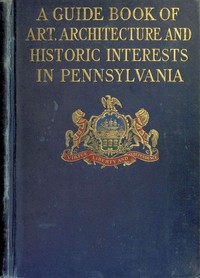
Before opening A guide book of art, architecture, and historic interests in Pennsylvania — A Closer Reading, the edition data offers a quick orientation: 105,810 words, 7 hr 41 min estimated reading time, and 17 detected text sections.
The text analysis averages about 25.0 words per sentence, while the detected sections provide another way to judge how the source is divided.
Project Gutenberg metadata also associates the work with “Historic buildings -- Pennsylvania,” connecting these edition facts with the source record’s subject description.
Explore this collection
These alternatives are selected using recorded categories and estimated reading time.
About 454 minutes
Architecture
104,381 recorded words. 7 minutes difference from this book's estimate.
View Gutenberg source #30172About 484 minutes
Architecture
111,272 recorded words. 23 minutes difference from this book's estimate.
View Gutenberg source #38866About 420 minutes
Architecture
96,404 recorded words. 41 minutes difference from this book's estimate.
View Gutenberg source #61255Search stored excerpts and compare books → Choose by your preferences →
Choices use stored catalog measurements. Estimates vary with reading speed. A shared category is a catalog label, not a claim that two books have the same argument or literary quality.
Search reads excerpt text stored with this catalog and links to its associated Gutenberg record. The connection is stored in the site database; this tool does not recheck that every excerpt is word-for-word identical to that external record. Excerpt search does not cover every chapter and does not verify historical publication dates.
Catalog snapshot checked: 2026-09-25. Coverage: 95 public books, 95 available source excerpts.
Read the complete public-domain text at its original source.
Read on Project GutenbergThe guidebook opens with a clear statement of purpose: it was “commenced by advice of Mrs. Edward Biddle” and “arranged chronologically, beginning with the counties first formed.” This immediately signals a methodical, historically grounded approach. The editor, A. Margaretta Archambault, chaired the Art Committee of the State Federation of Pennsylvania Women, and the book’s front matter includes a poem, “Hail! Pennsylvania,” and a list of committee members, establishing a civic, celebratory tone. The first excerpt from the Bedford County section shows how the guide blends military history (Fort Bedford, the Whiskey Insurrection) with architectural description (courthouse, post office, churches) and even mineral springs analysis, all within a few paragraphs.
The book’s plan is explicitly chronological: counties are treated in order of formation, and towns within each county are arranged by location. This structure, unusual for a modern guidebook, gives the reader a sense of historical layering. For example, Bedford County’s entry moves from the 1755 construction of a wagon road through the 1758 fort to the 1794 Whiskey Insurrection headquarters, then to the 1828 courthouse and 1915 post office. The reader is encouraged to see each town as a palimpsest of events and buildings. The excerpts do not reveal whether this pattern holds for all counties, but the consistency of the Bedford sample suggests a systematic approach.
Archambault’s stated aim is to catalog “works of good art” alongside “a story of most interesting pioneer history.” In practice, this means that a single entry can include the dimensions of a fort, the architectural style of a courthouse (“colonial with clock tower”), the therapeutic analysis of a spring (“carbonate of calcium, magnesium, iron and sodium”), and the names of commanding officers. The Bedford section, for instance, notes that the Colonial Hotel has “a colonnade of Doric columns, twenty feet high, made of native solid trees.” This juxtaposition of the aesthetic and the utilitarian is a defining feature of the guide. The reader should expect each county to offer a similar mix of military, civic, and natural history.
The excerpts demonstrate a remarkable attention to specific, verifiable facts. The Bedford entry gives exact street boundaries for the fort (“east by Richard Street; south, Pitt Street; west, Juliana Street; north, the Raystone River”), the number of troops (5,850 men), and the names of commanding officers (Colonel Bouquet, Colonel Washington). It also notes that the fort “embraced about seven thousand square yards.” This level of detail suggests the guide was compiled from primary sources or local records. The reader can trust that similar precision will appear throughout, making the book a reliable reference for historical markers and building dates. The inclusion of water analysis (“carbonate of calcium, magnesium, iron and sodium”) further underscores the scientific bent.
A first-time reader might begin with the front matter—the poem and committee list—to grasp the guide’s civic pride. Then, turning to the Bedford section, one sees the template: a county header with formation date and naming origin, followed by a narrative that moves from early roads to military events to modern buildings. The reader should note that the guide does not provide maps or illustrations in the excerpts, but the text itself functions as a verbal map, using street names and compass directions. The later excerpts (not shown) likely continue this pattern. The reader is advised to use the table of contents to jump to a county of interest, then read the entry as a continuous story rather than a list of facts.
This guidebook rewards a patient, attentive reading. Its chronological arrangement and dense local detail make it less a quick reference and more a historical narrative of Pennsylvania’s built environment. The reader should approach each county entry as a mini-essay, noting how Archambault weaves together military history, architecture, and natural resources. The book’s strength lies in its specificity; the reader is encouraged to verify details against current maps or historical societies, but the guide itself provides a rich starting point for exploration.
Reading this guidebook’s county-by-county wander through Pennsylvania’s old stone houses and pioneer names, I remembered my grandparents’ scrapbook—yellowed postcards, their handwritten labels. That same hushed pleasure of tracing places by hand. It came back, too, with Oxford Water-Colours — A Closer Reading, where each painted spire felt less like documentation than a quiet pause, a held breath of attention. Both books ask only that you look slowly.
Save your reaction, strongest insight, and memorable passage.









