About 15 minutes
Chester Water-Colours — Reading Companion
Architecture
3,368 recorded words. 1 minutes difference from this book's estimate.
View Gutenberg source #66086
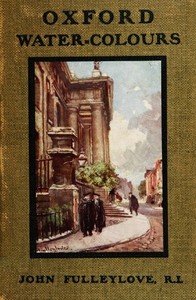
Oxford Water-Colours — A Closer Reading can be approached with a clearer sense of reading commitment from its source measurements: 3,678 words, 16 min estimated reading time, and 1 detected text section.
The text analysis averages about 19.6 words per sentence, while the detected sections provide another way to judge how the source is divided.
Project Gutenberg metadata also associates the work with “Watercolor painting, British,” connecting these edition facts with the source record’s subject description.
Explore this collection
These alternatives are selected using recorded categories and estimated reading time.
About 15 minutes
Architecture
3,368 recorded words. 1 minutes difference from this book's estimate.
View Gutenberg source #66086About 18 minutes
Architecture
3,982 recorded words. 2 minutes difference from this book's estimate.
View Gutenberg source #66942About 33 minutes
Architecture
7,518 recorded words. 17 minutes difference from this book's estimate.
View Gutenberg source #61801Search stored excerpts and compare books → Choose by your preferences →
Choices use stored catalog measurements. Estimates vary with reading speed. A shared category is a catalog label, not a claim that two books have the same argument or literary quality.
Search reads excerpt text stored with this catalog and links to its associated Gutenberg record. The connection is stored in the site database; this tool does not recheck that every excerpt is word-for-word identical to that external record. Excerpt search does not cover every chapter and does not verify historical publication dates.
Catalog snapshot checked: 2026-09-25. Coverage: 95 public books, 95 available source excerpts.
Read the complete public-domain text at its original source.
Read on Project GutenbergJohn Fulleylove's Oxford Water-Colours (1916) belongs to Black's 'Water-Colour' series, a set of illustrated volumes covering British and foreign locales. The catalog subjects—'Watercolor painting, British' and 'Oxford (England) — Pictorial works'—correctly place the book, but the excerpts reveal that the text is almost entirely descriptive captions for the plates, with no discussion of watercolour technique or artistic process. The work is essentially a topographical guide in pictorial form.
The catalog subject 'Watercolor painting, British' might lead a reader to expect commentary on brushwork, colour, or composition. However, the excerpts show that Fulleylove's captions concentrate on building history. For instance, the note on Tom Tower states: 'The Tower to the level of the finial of the ogee-headed window is of the date of Wolsey’s foundation; the remaining part was added by Sir Christopher Wren.' No mention is made of the watercolour rendering. Similarly, the caption for Corpus Christi College notes a 'cylindrical dial surmounted by a “pelican in her piety,” the badge'—again, an architectural or heraldic detail, not an artistic one. The book thus functions more as a visual record of Oxford's built environment than as a treatise on watercolour art.
The list of plates enumerates twenty watercolours, each tied to a specific Oxford location. The selection includes iconic college buildings (Tom Tower, Magdalen Tower, All Souls'), streetscapes (Broad Street, St. Giles's), and interiors (the Bodleian Library). The cover image, 'Oxford, from South Hinksey,' suggests a panoramic approach. The captions are brief—typically a single sentence identifying the subject and occasionally offering a historical fact. This format aligns with the series' apparent purpose: to provide a portable, visual tour for readers familiar with Oxford or interested in its architecture. The absence of any narrative or artistic analysis reinforces the book's role as a pictorial catalogue.
The catalog subjects are accurate but incomplete. 'Oxford (England) — Pictorial works' fits perfectly, as the book is a collection of images with minimal text. 'Watercolor painting, British' is technically correct—the images are watercolours—but the excerpts contain no discussion of the medium. A reader seeking insight into British watercolour painting would find little beyond the plates themselves. The book's true focus is architectural documentation, as evidenced by the captions' emphasis on dates, architects (Wolsey, Wren), and structural features. The catalog might usefully add 'Architecture—England—Oxford—Pictorial works' to better reflect the content. The excerpts offer no evidence of artistic evaluation or stylistic analysis.
Readers approaching Oxford Water-Colours should expect a visual record rather than a critical study. The captions provide historical context for the buildings depicted, but the watercolour medium itself remains unexamined. For those interested in early twentieth-century topographical illustration or Oxford's architectural heritage, this volume offers a concise portfolio. However, researchers seeking technical discussion of watercolour painting will need to look elsewhere.
Fulleylove’s watercolours always made me pause on the weight of old stone, how light settles on centuries of use. That same quiet patience lives in On the Lady Chapel in Chester Cathedral — Reading Companion, where the architecture feels less drawn than remembered. I keep both books near my chair, and return to them the way one returns to a familiar walk.
Save your reaction, strongest insight, and memorable passage.









