About 182 minutes
Cottage Building in Cob, Pisé, Chalk and Clay: A Renaissance (2nd edition) — Story, Setting & Ideas
Architecture
41,644 recorded words. 2 minutes difference from this book's estimate.
View Gutenberg source #32048
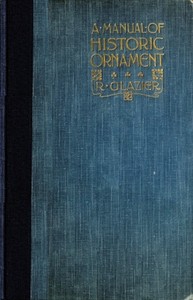
Before opening A Manual of Historic Ornament Treating upon the evolution, tradition, and development of architecture and other applied arts. Prepared for the use of students and craftsmen — Text and Context, the edition data offers a quick orientation: 42,307 words, 3 hr 4 min estimated reading time, and 9 detected text sections.
The text analysis averages about 19.6 words per sentence, while the detected sections provide another way to judge how the source is divided.
Project Gutenberg metadata also associates the work with “Decoration and ornament -- History,” connecting these edition facts with the source record’s subject description.
Explore this collection
These alternatives are selected using recorded categories and estimated reading time.
About 182 minutes
Architecture
41,644 recorded words. 2 minutes difference from this book's estimate.
View Gutenberg source #32048About 186 minutes
Architecture
42,604 recorded words. 2 minutes difference from this book's estimate.
View Gutenberg source #42547About 186 minutes
Architecture
42,609 recorded words. 2 minutes difference from this book's estimate.
View Gutenberg source #53495Search stored excerpts and compare books → Choose by your preferences →
Choices use stored catalog measurements. Estimates vary with reading speed. A shared category is a catalog label, not a claim that two books have the same argument or literary quality.
Search reads excerpt text stored with this catalog and links to its associated Gutenberg record. The connection is stored in the site database; this tool does not recheck that every excerpt is word-for-word identical to that external record. Excerpt search does not cover every chapter and does not verify historical publication dates.
Catalog snapshot checked: 2026-09-25. Coverage: 95 public books, 95 available source excerpts.
Read the complete public-domain text at its original source.
Read on Project GutenbergRichard Glazier, head master of the Municipal School of Art in Manchester, designed this 1899 manual as a practical resource for students and craftsmen, not as a decorative survey. The book’s 470 line illustrations, all drawn by the author, deliberately avoid pictorial effect to emphasize “definition, emphasis and the constructive qualities of design.” Glazier’s preface frames ornament as a record of “customs, myths and traditions” and insists on studying material constraints—the “capabilities and limitations of material” that shape every artifact.
The text moves from Oceanian and Egyptian ornament through Greek, Roman, Byzantine, and Islamic traditions, then into European ceramics and metalwork. A recurring tension appears between the author’s evolutionary narrative—tracing “continuity of line and form”—and his attention to abrupt cultural transfers, such as Persian pottery techniques carried by Arabians to Cairo and then to Spain.
Glazier’s choice of line drawings over halftones or color plates is a pedagogical argument. He writes that line gives “definition, emphasis and the constructive qualities of design rather than pictorial effect.” This is not a neutral format decision: it trains the eye to see structure—the ribbing on a Greek vase, the imbricated patterns on Chelsea cups, the “trailing lines” of Toft slipware. The illustrations are meant to be studied, not merely looked at.
The author’s own hand is everywhere. He produced every one of the 470 figures, which range from architectural plans to ceramic profiles to ornamental details. This uniformity of execution imposes a consistent visual language across cultures, subtly suggesting that a Greek meander and a Celtic interlace can be compared on the same terms. Yet the text occasionally undercuts this equivalence by stressing the irreducibility of local traditions—for instance, noting that in Persian pottery “form is subservient to colour,” a priority that line alone cannot fully convey.
The longest continuous excerpt in the manual concerns pottery, and it reveals Glazier’s method: he traces technical innovations along trade and conquest routes. Maiolica, he explains, originated in Persia, was carried by Arabians to Fustat (old Cairo), introduced to Spain by Moors, and perfected as Hispano-Moresque ware with “central heraldic arms, surrounded by concentric bands of foliage.” The name itself comes from Majorca, where Persian and Arabian potters worked before the Pisan conquest.
Glazier is precise about materials and dates. He notes that English Rockingham ware (1759–1788) was “but a fine earthenware, of a hard and compact body, covered with a rich brown or chocolate glaze,” and that a dessert service for William IV in 1832 cost £5,000. He distinguishes transfer-printed outlines from hand-coloring, and identifies the “stanniferous or tin glaze” that defines true enamel. These details ground the narrative in workshop practice rather than aesthetic theory.
Glazier organizes ornament by culture and period, but his categories are porous. The chapter on English earthenware praises the “vitality and personality” of individual founders—Elers, Wedgwood, the Toft school—while acknowledging that their work remained “traditional.” He sees national character in material choices: Greek vases exhibit “beauty of form” as “the natural outcome of a fine earthenware in the hands of an artistic people,” whereas Persian potters subordinate form to color.
This comparative framework is not neutral. Glazier’s training as an architect and his role at a municipal art school shape his priorities: he values construction, line, and the “appropriateness and application of ornament.” The manual’s final sections on stained glass, goldsmithing, and enamels continue this emphasis on technique. A reader comes away with a craftsman’s vocabulary—imbricated, stanniferous, lustered—rather than a connoisseur’s appreciation.
Glazier’s manual is best read as a period document of art education, not as a comprehensive history. Its strengths are its specificity about materials and processes, its author-drawn illustrations, and its insistence on ornament as a record of social and religious life. Readers should note that the text reflects late-Victorian assumptions about cultural evolution and national character. The appendix lists contemporary textbooks, offering a glimpse into the canon Glazier expected his students to master.
I’d forgotten how Glazier’s drawings made each clay pot feel like a quiet witness, until I came across my old copy’s marginal note about continuity. It turned me toward the later volume, Historic Ornament, Vol. 2 (of 2) Treatise on decorative art and architectural ornament — Edition Insights, and something in the way those plates traced the same lineage felt like an old friend finishing a story I’d started long ago.
Answer a few questions and save a private reflection on this device.









