About 518 minutes
Naturalistic Photography for Students of the Art. — Themes and Context
Painting Sculpture
119,002 recorded words. 52 minutes difference from this book's estimate.
View Gutenberg source #56833
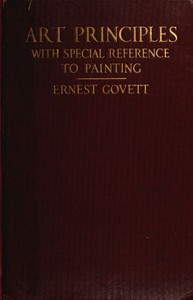
For Art Principles with Special Reference to Painting Together with Notes on the Illusions Produced by the Painter — Background and Themes, the stored edition analysis reports 107,101 words, 7 hr 46 min estimated reading time, and 23 detected text sections.
The text analysis averages about 26.7 words per sentence, while the detected sections provide another way to judge how the source is divided.
Project Gutenberg metadata also associates the work with “Art,” connecting these edition facts with the source record’s subject description.
Explore this collection
These alternatives are selected using recorded categories and estimated reading time.
About 518 minutes
Painting Sculpture
119,002 recorded words. 52 minutes difference from this book's estimate.
View Gutenberg source #56833About 546 minutes
Painting Sculpture
125,382 recorded words. 80 minutes difference from this book's estimate.
View Gutenberg source #40149About 374 minutes
Painting Sculpture
85,949 recorded words. 92 minutes difference from this book's estimate.
View Gutenberg source #24726Search stored excerpts and compare books → Choose by your preferences →
Choices use stored catalog measurements. Estimates vary with reading speed. A shared category is a catalog label, not a claim that two books have the same argument or literary quality.
Search reads excerpt text stored with this catalog and links to its associated Gutenberg record. The connection is stored in the site database; this tool does not recheck that every excerpt is word-for-word identical to that external record. Excerpt search does not cover every chapter and does not verify historical publication dates.
Catalog snapshot checked: 2026-09-25. Coverage: 95 public books, 95 available source excerpts.
Read the complete public-domain text at its original source.
Read on Project GutenbergErnest Govett opens his 1919 treatise with an unusual confession: the book is 'little more than a skeleton,' curtailed by wartime hindrances to research. This candor sets the tone for a work that is less a polished doctrine than a series of provocative propositions, anchored by what he calls the 'Law of General Assent'—a standard he first floated in an earlier pseudonymous publication. Govett does not claim finality; he offers his ideas as a 'ballon d'essai,' inviting further inquiry.
The excerpts reveal a writer deeply engaged with technical problems of pictorial illusion. He dissects how painters create depth and motion, contrasting Hobbema's late-career backlighting technique with earlier side-lit attempts, and analyzing how flowing water can be segmented into a 'series of progressive natural actions' to suggest movement. These are not abstract musings but grounded observations tied to specific artists and works.
Govett's central theoretical contribution is the 'Law of General Assent,' a criterion for aesthetic judgment that he claims survived scrutiny after his earlier publication. He presents it as a resolution to 'the apparent contradictions involved in the numerous suggested standards of art.' Yet the excerpts do not fully define this law; Govett acknowledges the book's incompleteness, noting that sections on illusions contain 'only a few suggestions and instances.' Readers should approach the law as a work-in-progress, not a settled formula. The preface suggests that Govett's ambition once extended to 'all the principles of painting,' but the final text is deliberately circumscribed. This tension between aspiration and limitation is itself a key feature of the work.
Govett's most concrete analyses focus on how painters create spatial and kinetic illusions. He identifies Hobbema's method of placing 'strong sunlight from the back' as 'the only really first-class method' for near-ground depth, arguing that backlighting allows more 'signs' (trees, paths) to be used without obscuring the view. He contrasts this with Hobbema's earlier side-lit works, which were 'decidedly inferior.' For motion, Govett examines flowing water: a cascade over multiple ledges and rocks produces 'a series of progressive natural actions' that the eye can separate, generating an illusion of movement. He credits Everdingen and Jacob Ruysdael as pioneers in recognizing this principle. These passages are notable for their technical specificity and reliance on observable pictorial features.
Throughout the excerpts, Govett repeatedly emphasizes the book's provisional nature. He describes it as 'put forward with much diffidence,' aware of its 'insufficiencies.' The war is cited as a principal obstacle, forcing him to 'curtail my ambition.' He even suggests that 'if one has something to say, it is better to say it incompletely than to run the risk of compulsory silence.' This self-deprecating frame is unusual in a theoretical work and shapes how readers should interpret the arguments. The notes, relegated to the end, are described as 'voluminous,' hinting at a larger evidentiary base not fully integrated into the main text. Govett's voice is that of a scholar who has spent 'many years' gathering materials but ultimately chose to publish a fragment rather than remain silent.
Govett's book rewards readers who attend to its technical passages rather than its overarching claims. The most valuable sections are those where he compares specific painterly strategies—Hobbema's backlighting versus side-lighting, or the segmentation of water flow—because these are grounded in observable works. The 'Law of General Assent' remains tantalizingly underdeveloped, but the illusion analyses offer concrete criteria for evaluating landscape painting. Approach the text as a collection of sharp observations embedded in an unfinished framework.
I sometimes think of Govett’s unfinished pages, that wartime honesty about gaps left unfilled, and then I wander over to The Bases of Design — Edition Insights, which feels like a patient friend picking up the dropped thread. Two quiet companions, each knowing the other’s struggle with incompletion, yet content in their shared, half-lit space.
Capture what you thought, learned, and would like to remember.