About 402 minutes
Pictures Every Child Should Know A Selection of the World's Art Masterpieces for Young People — A Closer Reading
Art History
92,293 recorded words. 2 minutes difference from this book's estimate.
View Gutenberg source #6932
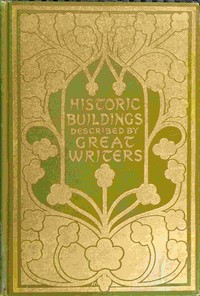
This digital edition of Historic buildings — Context and Discussion is described by source-level measurements including 91,975 words, 6 hr 40 min estimated reading time, and 50 detected text sections.
The text analysis averages about 26.8 words per sentence, while the detected sections provide another way to judge how the source is divided.
Project Gutenberg metadata also associates the work with “Architecture -- History,” connecting these edition facts with the source record’s subject description.
Explore this collection
These alternatives are selected using recorded categories and estimated reading time.
About 402 minutes
Art History
92,293 recorded words. 2 minutes difference from this book's estimate.
View Gutenberg source #6932About 253 minutes
Art History
58,053 recorded words. 147 minutes difference from this book's estimate.
View Gutenberg source #11924About 174 minutes
Art History
39,800 recorded words. 226 minutes difference from this book's estimate.
View Gutenberg source #168Search stored excerpts and compare books → Choose by your preferences →
Choices use stored catalog measurements. Estimates vary with reading speed. A shared category is a catalog label, not a claim that two books have the same argument or literary quality.
Search reads excerpt text stored with this catalog and links to its associated Gutenberg record. The connection is stored in the site database; this tool does not recheck that every excerpt is word-for-word identical to that external record. Excerpt search does not cover every chapter and does not verify historical publication dates.
Catalog snapshot checked: 2026-09-25. Coverage: 95 public books, 95 available source excerpts.
Read the complete public-domain text at its original source.
Read on Project GutenbergEsther Singleton's Historic Buildings (1903) assembles descriptions of notable structures written by travelers, historians, and novelists, each excerpt chosen for its blend of architectural observation and historical narrative. The editor's preface states two guiding principles: "the beauty or interest from an artistic standpoint" and "the historical associations." This dual focus shapes the anthology's structure, moving from mosques and cathedrals to castles and fortresses across Europe and Asia. Singleton, who translated several pieces herself, notes that she "took no liberties with the text, except a little cutting for the sake of space limitations." The result is a collection that preserves the distinct voices of its contributors—from John Ruskin's ornate prose on San Donato to Charles Dickens's more direct account of the Palace of the Popes—while offering readers a comparative view of architectural styles and the events that unfolded within these walls.
The anthology's primary interest lies in its variety of narrative voices. Singleton does not impose a uniform style; instead, she lets each writer's approach stand. John Ruskin's description of San Donato, Murano, is dense with aesthetic judgment and moral weight, typical of his art criticism. In contrast, G. W. Steevens's account of the Jumma Musjid in Delhi is more journalistic, focusing on the building's scale and the life around it. Pierre Loti's excerpt on the Church of the Holy Sepulchre brings a sensory, almost novelistic intensity, while the passage on Carisbrooke Castle (author not specified in the excerpt) reads like a compressed chronicle of ownership and sieges. This juxtaposition allows readers to compare how different writers frame architecture: as art, as history, or as lived space. The shifts in pace and detail from one selection to the next mirror the buildings' own varied functions and histories.
Singleton's selections repeatedly treat buildings as documents of political and cultural change. The Carisbrooke Castle excerpt, for instance, traces its lords from William Fitz Osborne through the Redvers family to the Crown, noting how each phase of construction—the Norman keep, the Elizabethan outworks—reflects the military and dynastic concerns of its era. The editor explicitly invites such analysis: she writes that studying the cathedrals of Monreale and Palermo "will demonstrate the presence of Norman and Saracen in Sicily." Similarly, she presents Shah Jehan's mosques and the Taj Mahal as "monuments not only to the great conqueror, but to the magnificence of his taste." The buildings are never merely aesthetic objects; they are evidence of conquest, piety, and power. The excerpts often include precise details about construction dates, patrons, and alterations, grounding the descriptions in verifiable history rather than mere impression.
The anthology's pacing varies considerably between entries. Some, like the Carisbrooke passage, pack centuries of ownership into a single paragraph, creating a breathless sense of historical accumulation. Others, such as the description of the Jumma Musjid, slow down to evoke the building's physical presence and the daily life around it. This variation is partly a result of Singleton's editing: she cut excerpts "for the sake of space limitations," which sometimes compresses narrative and sometimes preserves a writer's leisurely observation. The effect is that the reader moves between rapid historical summaries and more contemplative architectural portraits. The collection's structure—50 sections covering buildings from the Holy Sepulchre to La Grande Chartreuse—ensures that no single pace dominates, encouraging readers to adjust their attention with each new entry.
Readers approaching Historic Buildings should treat it as a curated anthology rather than a unified guide. The value lies in comparing how different writers—and different eras—describe architecture. Singleton's editorial hand is light, but her choices reveal a consistent interest in buildings as sites of historical drama. The book rewards those who read across entries, noting how the same building might be described by another writer in a different volume of the series. For students of architecture or history, it offers a primary-source view of how late-nineteenth-century readers encountered these monuments through the words of celebrated authors.
I keep thinking about how Esther Singleton let old stones speak through the people who once stood before them, hushed and awed. It lingered like a half-remembered cathedral hymn. Later, I found a quieter echo in The Beautiful Necessity Seven Essays on Theosophy and Architecture — A Closer Reading, where brick and mortar seem to carry something almost sacred, unhurried, like a thought you return to without meaning to.
Your answers remain private and are stored only in this browser.