About 402 minutes
The Architecture of Provence and the Riviera — Key Ideas to Explore
Design Photography
92,323 recorded words. 3 minutes difference from this book's estimate.
View Gutenberg source #58284
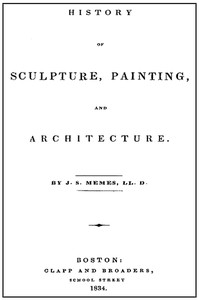
History of Sculpture, Painting, and Architecture — Text and Context can be approached with a clearer sense of reading commitment from its source measurements: 92,936 words, 6 hr 45 min estimated reading time, and 24 detected text sections.
The text analysis averages about 30.2 words per sentence, while the detected sections provide another way to judge how the source is divided.
Project Gutenberg metadata also associates the work with “Art -- History,” connecting these edition facts with the source record’s subject description.
Explore this collection
These alternatives are selected using recorded categories and estimated reading time.
About 402 minutes
Design Photography
92,323 recorded words. 3 minutes difference from this book's estimate.
View Gutenberg source #58284About 365 minutes
Design Photography
83,735 recorded words. 40 minutes difference from this book's estimate.
View Gutenberg source #35898About 458 minutes
Design Photography
105,204 recorded words. 53 minutes difference from this book's estimate.
View Gutenberg source #29077Search stored excerpts and compare books → Choose by your preferences →
Choices use stored catalog measurements. Estimates vary with reading speed. A shared category is a catalog label, not a claim that two books have the same argument or literary quality.
Search reads excerpt text stored with this catalog and links to its associated Gutenberg record. The connection is stored in the site database; this tool does not recheck that every excerpt is word-for-word identical to that external record. Excerpt search does not cover every chapter and does not verify historical publication dates.
Catalog snapshot checked: 2026-09-25. Coverage: 95 public books, 95 available source excerpts.
Read the complete public-domain text at its original source.
Read on Project GutenbergJ. S. Memes opens his History of Sculpture, Painting, and Architecture with a dedication to William Jack, D.D., and a table of contents that reveals a tripartite structure: sculpture (chapters I–IX), painting (X–XIV), and architecture (XV–XVII). The preface, though not fully excerpted, signals the author's intention to offer a concise survey for a general audience. From the first pages, Memes establishes a comparative framework, grouping schools by nation and period—Egyptian, Greek, Italian, German, Flemish, Dutch, French, English—and evaluating them against classical ideals. His critical vocabulary, including terms like "ideal art," "school of beauty," and "Gothic manner," alerts readers to his aesthetic criteria. The opening thus primes the reader for a narrative of rise, decline, and revival, with particular attention to the Italian Renaissance and its aftermath.
Memes consistently compares artists and schools, often ranking them. In the painting section, he contrasts Camuccini and Benvenuti: the former is "the best draughtsman in Europe" but "inferior as a colorist," while the latter excels in color and grouping but is inferior in drawing and classical taste. Such paired judgments appear throughout. For German art, he distinguishes three schools—German, Flemish, Dutch—calling these distinctions "rather local than depending upon characteristic difference of manner." He then evaluates Albert Durer as "the Da Vinci of this school," praising his science and art while noting his "ignorance of the antique." These comparisons help the reader understand Memes's hierarchy of values: drawing, composition, expression, and classical reference are paramount.
Memes uses a specialized lexicon that rewards attention. Terms like "ideal art," "school of beauty," and "Gothic manner" recur. In the sculpture section, he speaks of "the perfection of material art" and "methods of composition among the Greek sculptors." For painting, he describes early German works as "painted upon wood, usually oak, covered sometimes with canvass, always with a white ground, upon which the outline of the subject is sketched." This technical detail grounds his aesthetic judgments. He also employs evaluative phrases: Camuccini's expression is "cold—deficient in that warm gush of sentiment." Such language reveals his Romantic-era sensibility, valuing emotional warmth alongside classical form. Readers should note how these terms shape his narrative of artistic progress and decline.
The table of contents reveals Memes's priorities. Sculpture receives nine chapters, painting five, architecture three. Within sculpture, Greek art occupies chapters II–IV, while the revival from Canova onward gets only chapter IX. Painting devotes two chapters to the English school, reflecting the author's likely British audience. Architecture begins with Egyptian, Syrian, and Indian design, then moves to Greek orders (Doric, Ionic, Corinthian), Roman, and finally medieval Gothic and Renaissance. This structure suggests a narrative arc from ancient origins to modern practice, with the Italian Renaissance as a peak. The later excerpts, discussing early eighteenth-century Roman painters and the German school, show Memes bringing the story up to his own time, ending with living artists like Camuccini and Benvenuti.
The excerpts cover only the preface, table of contents, and parts of chapters XII and the later painting section. They do not include the sculpture or architecture chapters, nor the full treatment of any school. Therefore, while we can observe Memes's comparative method and critical vocabulary, we cannot assess his arguments about Greek sculpture, Gothic architecture, or the English school. His judgments on Camuccini and Benvenuti are vivid but may not represent his overall view of contemporary art. Readers should treat these passages as samples of his style and criteria, not as definitive summaries. The work's full argument about the causes of artistic decline and revival—touched on in chapter titles like "Influence of Liberty" and "Influence of the Reformation"—remains to be explored.
For a first reading, attend to Memes's comparative structure and his evaluative language. Note how he pairs artists and schools, and how his technical descriptions support his judgments. The table of contents is a reliable map of his emphases. Because the excerpts are partial, avoid drawing conclusions about the work's overall thesis until you have read the missing chapters. This edition, published in Boston in 1834, reflects an early nineteenth-century perspective that prizes classical ideals while acknowledging modern developments.
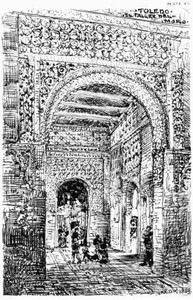
I found myself thinking of Memes’s old survey the other day, how patiently it traces stone and pigment through centuries of hands. There’s a similar tenderness in An Architect's Note-Book in Spain principally illustrating the domestic architecture of that country. — Story, Setting & Ideas, where even humble doorways seem to hold their own quiet history, waiting for someone to simply sit with them, as I have, many a quiet evening.
Save your reaction, strongest insight, and memorable passage.