About 191 minutes
Some old masters of Greek architecture — A Reader’s Guide
Architecture
43,815 recorded words. 4 minutes difference from this book's estimate.
View Gutenberg source #75561
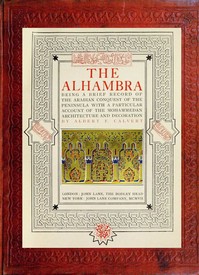
The catalog record for The Alhambra being a brief record of the Arabian conquest of the Peninsula with a particular account of the Mohammedan architecture and decoration — A Reader’s Guide provides practical reading context through 44,786 words, 3 hr 15 min estimated reading time, and 12 detected text sections.
The text analysis averages about 20.2 words per sentence, while the detected sections provide another way to judge how the source is divided.
Project Gutenberg metadata also associates the work with “Alhambra (Granada, Spain),” connecting these edition facts with the source record’s subject description.
Explore this collection
These alternatives are selected using recorded categories and estimated reading time.
About 191 minutes
Architecture
43,815 recorded words. 4 minutes difference from this book's estimate.
View Gutenberg source #75561About 186 minutes
Architecture
42,604 recorded words. 9 minutes difference from this book's estimate.
View Gutenberg source #42547About 186 minutes
Architecture
42,609 recorded words. 9 minutes difference from this book's estimate.
View Gutenberg source #53495Search stored excerpts and compare books → Choose by your preferences →
Choices use stored catalog measurements. Estimates vary with reading speed. A shared category is a catalog label, not a claim that two books have the same argument or literary quality.
Search reads excerpt text stored with this catalog and links to its associated Gutenberg record. The connection is stored in the site database; this tool does not recheck that every excerpt is word-for-word identical to that external record. Excerpt search does not cover every chapter and does not verify historical publication dates.
Catalog snapshot checked: 2026-09-25. Coverage: 95 public books, 95 available source excerpts.
Read the complete public-domain text at its original source.
Read on Project GutenbergCalvert opens his volume with a Spanish popular rhyme contrasting Seville and Granada, then dedicates the book to King Alfonso XIII, signaling both his intended audience and his reliance on royal patronage. The preface frames the work as a remedy for the lack of an "adequate illustrated souvenir" for the ordinary tourist, distinguishing it from costly scholarly tomes. He describes the Alhambra as an "exquisite opera" whose magic can be recalled through memory—a metaphor that sets the tone for a guide that aims to preserve and evoke the experience of the palace.
The book's structure is immediately apparent from its extensive list of illustrations, including forty plates numbered with Roman numerals and ground plans with lettered keys. Calvert expects readers to move between text and image: a plate caption for the baths, for instance, notes that copper vessels were sold for "14,000 reals, about £350 sterling," a precise detail that grounds the architecture in historical economy. The plans use a system of letters (A through K) to label rooms, passages, and baths, inviting the reader to trace the layout while reading. This cross-referencing between verbal description and visual diagram is central to Calvert's method.
In the section on the Court of the Fish-Pond (also called the Court of the Myrtles), Calvert offers a close reading of construction and ornament. He notes that the slender columns support brick piers, with spandrils "lightened by perforations" and filled with diagonally placed tiles. The plaster ornaments, he observes, are in better preservation here than elsewhere. He speculates about stained glass in the windows, citing a wall near the Hall of Ambassadors where "small spaces are painted of various colours"—an inference he marks as conjecture. The repeated motto "There is no Conqueror but God" appears on escutcheons, enclosed in a cipher formed by the word "Grace" written twice in Cufic characters.
Calvert alternates between technical analysis and sensory evocation. In the baths section, he writes: "Air and water are the perpetual treasures of this place, and I tasted them both gratefully as I strode under the pointed arches, away from the burning lashes of the sun." This first-person observation, rare in the excerpts, momentarily shifts the register from guidebook to travel memoir. Yet he immediately returns to architectural specifics, describing the pierced marble balustrade and the "pointed arches" that structure the space. The juxtaposition of personal impression and measured description gives the text a dual character: it is both a reference work and a record of a visit.
The provided excerpts cover the preface, plate lists, and a portion of the Court of the Fish-Pond description, but they do not include the historical narrative of the Arabian conquest promised in the subtitle. Calvert's claim to offer a "concise history and description" suggests that the full work likely moves between historical context and architectural survey. Readers should expect the plates and ground plans to be essential to following the argument; the text alone, without the images, will feel incomplete. The excerpts also hint at a tension between popular and scholarly aims—the preface addresses the "general public," while the detailed plate references assume a studious reader.
Calvert's Alhambra is best approached as a guided tour in book form, where the reader is expected to pause at each plate and plan. The preface's metaphor of the Alhambra as an opera whose "witchery" can be recalled by a whistled air suggests that Calvert hopes his text will serve as a mnemonic trigger. To read it effectively, keep the illustrations at hand, trace the lettered plans, and note where Calvert marks his own inferences as conjecture. The book rewards a slow, attentive reading that moves between word and image.
Rain tapped the window while Calvert’s plates turned rust-gold beneath my lamp, his measured praise of plaster and tile settling into me like warmth. Later, leafing through my notes, a stray margin sketch of a cathedral arch appeared—and sent me, quietly, toward On the Lady Chapel in Chester Cathedral — Reading Companion. One stone’s stillness speaks to another’s, even hundreds of years apart.
Build a private reading journal entry for this title.









