About 53 minutes
The Mentor: Painters of Western Life, Vol 3, Num. 9, Serial No. 85, June 15, 1915 — Background and Themes
Architecture
11,972 recorded words. 1 minutes difference from this book's estimate.
View Gutenberg source #50803
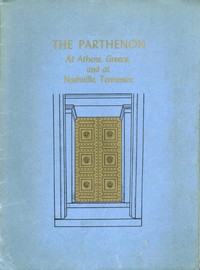
For The Parthenon at Athens, Greece and at Nashville, Tennessee — Text and Context, the stored edition analysis reports 11,937 words, 52 min estimated reading time, and 2 detected text sections.
The text analysis averages about 24.9 words per sentence, while the detected sections provide another way to judge how the source is divided.
Project Gutenberg metadata also associates the work with “Parthenon (Athens, Greece),” connecting these edition facts with the source record’s subject description.
Explore this collection
These alternatives are selected using recorded categories and estimated reading time.
About 53 minutes
Architecture
11,972 recorded words. 1 minutes difference from this book's estimate.
View Gutenberg source #50803About 49 minutes
Architecture
11,255 recorded words. 3 minutes difference from this book's estimate.
View Gutenberg source #33350About 48 minutes
Architecture
10,905 recorded words. 4 minutes difference from this book's estimate.
View Gutenberg source #72812Search stored excerpts and compare books → Choose by your preferences →
Choices use stored catalog measurements. Estimates vary with reading speed. A shared category is a catalog label, not a claim that two books have the same argument or literary quality.
Search reads excerpt text stored with this catalog and links to its associated Gutenberg record. The connection is stored in the site database; this tool does not recheck that every excerpt is word-for-word identical to that external record. Excerpt search does not cover every chapter and does not verify historical publication dates.
Catalog snapshot checked: 2026-09-25. Coverage: 95 public books, 95 available source excerpts.
Read the complete public-domain text at its original source.
Read on Project GutenbergBenjamin Franklin Wilson III, director of the Nashville Parthenon, wrote this booklet to document the replica’s fidelity to the Athenian original. He draws on his direct oversight of the Nashville project, offering observations on materials, dimensions, and sculptural elements. The text is structured as a comparative analysis, moving from the Greek temple’s history to the American reproduction’s design choices.
Wilson’s position as director of the Nashville Parthenon shapes the booklet’s authority. He writes from firsthand knowledge of the replica’s construction, noting, for instance, that the Ionic frieze was omitted “for lack of funds.” This admission reveals practical constraints behind the reproduction. His dedication to the Board of Park Commissioners (1920–1941) further anchors the text in a specific civic project. Wilson does not claim aesthetic equivalence; instead, he treats the Nashville building as an ongoing work, stating that the frieze “will eventually find its place on the temple.”
Wilson distinguishes two frieze systems. The Ionic frieze, running along the outer walls, depicted the Panathenaic Procession with “approximately six hundred figures” — no two alike. He traces its Assyrian influence in low relief and small scale. The Doric frieze, by contrast, uses triglyphs and metopes: ninety-two panels, each about four feet square, telling mythological stories. Wilson notes that the Doric figures are “archaic and stiff,” suggesting they were transferred from an earlier temple rather than carved by Phidias. This technical judgment avoids romanticizing the originals.
Wilson repeatedly acknowledges gaps in the Nashville version. Besides the missing Ionic frieze, he implies that other elements remain unfinished. His tone is matter-of-fact: the frieze is “available” in the British Museum and Louvre, with twenty-four feet still on the Athenian ruin. He does not speculate on a completion date. This candor sets the booklet apart from boosterish accounts. Wilson treats the replica as a process, not a finished monument, and his language — “lacks that much of being completed” — underscores the provisional nature of the project.
Wilson situates the Parthenon within Greek religious life, asserting that “every function of the mind, every activity of the hand, was closely associated with some god or goddess.” He links the building’s endurance to the “co-ordination of mind, hand, and heart” of its builders. Yet he avoids hyperbole: the Parthenon was “not thought to be one of the wonders of the world.” This measured praise, combined with specific references to Phidias, Sophocles, and Ictinos, grounds the text in historical figures rather than vague admiration.
Wilson notes that the pediments contained “twenty-eight of the major deities and numerous minor deities and personifications,” covering much of Greek mythology. He describes the west pediment’s depiction of the contest between Athena and Poseidon, though the excerpt cuts off before full details. His emphasis on the sculptural program’s comprehensiveness — “the mythological stories of the Parthenon largely cover the mythology of Greece” — suggests that the building functioned as a visual encyclopedia of Greek belief.
Wilson’s booklet is best read as a technical companion rather than a general history. Readers interested in the Nashville replica will find precise details about its construction and limitations. Those focused on the Athenian original will encounter a director’s perspective on what was deemed essential to reproduce — and what was left out. The text rewards attention to Wilson’s choices of what to emphasize and what to acknowledge as incomplete.
Flipping through the Nashville replica’s carved metopes, I found myself less concerned with exactitude than with the hands that shaped them—what those sculptors felt, copying gods from plaster casts. It reminded me, softly, of The mind of the artist — Context and Discussion, a book that lingers on intention rather than finish. Both buildings hold that quiet hum of human thought, pressed into stone.
Build a private reading journal entry for this title.









