About 52 minutes
The Parthenon at Athens, Greece and at Nashville, Tennessee — Text and Context
Architecture
11,937 recorded words. 1 minutes difference from this book's estimate.
View Gutenberg source #58665
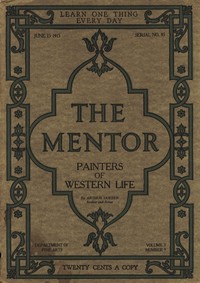
Before opening The Mentor: Painters of Western Life, Vol 3, Num. 9, Serial No. 85, June 15, 1915 — Background and Themes, the edition data offers a quick orientation: 11,972 words, 53 min estimated reading time, and 2 detected text sections.
The text analysis averages about 20.8 words per sentence, while the detected sections provide another way to judge how the source is divided.
Project Gutenberg metadata also associates the work with “Painting -- United States,” connecting these edition facts with the source record’s subject description.
Explore this collection
These alternatives are selected using recorded categories and estimated reading time.
About 52 minutes
Architecture
11,937 recorded words. 1 minutes difference from this book's estimate.
View Gutenberg source #58665About 49 minutes
Architecture
11,255 recorded words. 4 minutes difference from this book's estimate.
View Gutenberg source #33350About 48 minutes
Architecture
10,905 recorded words. 5 minutes difference from this book's estimate.
View Gutenberg source #72812Search stored excerpts and compare books → Choose by your preferences →
Choices use stored catalog measurements. Estimates vary with reading speed. A shared category is a catalog label, not a claim that two books have the same argument or literary quality.
Search reads excerpt text stored with this catalog and links to its associated Gutenberg record. The connection is stored in the site database; this tool does not recheck that every excerpt is word-for-word identical to that external record. Excerpt search does not cover every chapter and does not verify historical publication dates.
Catalog snapshot checked: 2026-09-25. Coverage: 95 public books, 95 available source excerpts.
Read the complete public-domain text at its original source.
Read on Project GutenbergArthur Hoeber's 1915 issue of The Mentor opens not with a painter but with a chess metaphor borrowed from Thomas Huxley, framing life as a game whose rules are the laws of nature. This philosophical prelude sets an unexpected tone for a discussion of Western American art, suggesting that the artists profiled—Frederic Remington and Charles M. Russell—are players who understood the game of the West intimately. The opening immediately establishes that the text will blend biography with broader reflection, a pattern that continues throughout.
The monograph on Frederic Remington emphasizes his vigorous life as much as his art. Hoeber notes that Remington assisted Walter Camp in inventing American football at Yale, and that he was an "indefatigable worker" who filled sketchbooks with notes. The text traces his progress in technique, stating that "each succeeding picture disclosing genuine advance." Notably, Hoeber also mentions Remington's later success in sculpture, singling out "The Broncho Buster" as a public favorite. The biographical details—his father being a newspaperman, his brief time at Yale Art School—are presented as formative, but the focus remains on how his outdoor life fed his art. The excerpt avoids direct quotation of Remington's own words, relying instead on Hoeber's assessment of his character as "a delight to a host of friends."
Charles M. Russell is introduced as "an artist very distinctive of the soil," one who had been a veritable cowboy and lived among Indians, speaking tribal languages and the sign language. Hoeber emphasizes that Russell never attended art school; artistically, "like Topsy, he just grew." The text highlights his practical skills—throwing the lariat, adeptness with a pistol, hunting buffalo—as credentials for painting the West. His illustrations for Stewart Edward White's Arizona Nights and Emerson Hough's Story of the Outlaw are cited as early successes. The excerpt notes that Russell's work attracted English weeklies, and that his transition to painting was natural. Hoeber frames Russell's success as surprising to the artist himself, who drew "because of his great love of the work."
Hoeber contrasts the earlier, more picturesque West with the modern, civilized version: "stern men in blue and khaki have seen to it that the Indian is kept on his reservation; business men with the wire fences now look after the interests of investors." This observation appears in the Russell section, but it echoes a theme that likely runs through the entire issue. The text suggests that the artists' value lies in preserving a memory of conditions that no longer exist. Russell's memory of earlier times is described as distinct, and his paintings are called "true transcripts." The excerpts do not reveal whether Hoeber extends this lament to Remington's work, but the pattern of pairing biography with cultural commentary is consistent.
The issue is organized as a series of monographs, each devoted to a single artist. The opening chess analogy may seem disconnected, but it primes the reader to view the artists as players who mastered the rules of their environment. The biographical details are not mere filler; they serve as evidence of each artist's qualification to depict the West. A first-time reader should pay attention to how Hoeber weaves together personal history, artistic technique, and cultural context. The excerpts suggest that the text does not provide deep analysis of individual paintings; instead, it offers a portrait of the artist as a product of the West. The closing sections of the original issue likely reinforce this approach, but the excerpts end before that point.
Readers approaching this Mentor issue for the first time will benefit from noting how Hoeber uses biography to authenticate artistic vision. The chess metaphor at the start is not a gimmick; it frames the entire discussion as a game of skill and observation. Pay attention to the recurring emphasis on firsthand experience—Remington's football and sketching, Russell's cowboy life—as the foundation of their art. The issue is as much about the character of the West as it is about the painters who captured it.
That rainy June afternoon, I stayed with Hoeber’s commentary on Remington’s wide, lonely plains until the light failed. His careful arrangement of biography and brushwork made the West feel patient, almost waiting. Later, half-dreaming, I reached for The Haciendas of Mexico: An Artist's Record — Key Ideas to Explore, and found the same unhurried quiet there—stone courtyards holding their own stories, neither book asking for more than a second glance.
Capture what you thought, learned, and would like to remember.









