About 235 minutes
Stained glass of the middle ages in England and France — Context and Discussion
Architecture
53,894 recorded words. 8 minutes difference from this book's estimate.
View Gutenberg source #41370
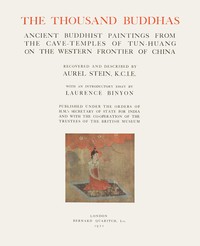
The source record for The Thousand Buddhas Ancient Buddhist Paintings from the Cave-Temples of Tun-huang on the Western Frontier of China — Key Ideas to Explore measures this digital text at 52,107 words, 3 hr 47 min estimated reading time, and 51 detected text sections.
The text analysis averages about 19.9 words per sentence, while the detected sections provide another way to judge how the source is divided.
Project Gutenberg metadata also associates the work with “Painting, Chinese,” connecting these edition facts with the source record’s subject description.
Explore this collection
These alternatives are selected using recorded categories and estimated reading time.
About 235 minutes
Architecture
53,894 recorded words. 8 minutes difference from this book's estimate.
View Gutenberg source #41370About 239 minutes
Architecture
54,770 recorded words. 12 minutes difference from this book's estimate.
View Gutenberg source #34897About 239 minutes
Architecture
54,907 recorded words. 12 minutes difference from this book's estimate.
View Gutenberg source #42982Search stored excerpts and compare books → Choose by your preferences →
Choices use stored catalog measurements. Estimates vary with reading speed. A shared category is a catalog label, not a claim that two books have the same argument or literary quality.
Search reads excerpt text stored with this catalog and links to its associated Gutenberg record. The connection is stored in the site database; this tool does not recheck that every excerpt is word-for-word identical to that external record. Excerpt search does not cover every chapter and does not verify historical publication dates.
Catalog snapshot checked: 2026-09-25. Coverage: 95 public books, 95 available source excerpts.
Read the complete public-domain text at its original source.
Read on Project GutenbergLaurence Binyon's introductory essay and Aurel Stein's descriptive catalogue together form a meticulous record of Buddhist paintings recovered from the Cave-Temples of Tun-huang. The volume documents over forty plates, each accompanied by Stein's observations on iconography, style, and physical condition. Binyon's essay situates the paintings within the broader tradition of Buddhist art, while Stein's entries attend to specific details: the colour of a Bodhisattva's hair, the pattern of a nimbus border, or the pose of a donor figure.
The excerpts reveal a work that oscillates between two modes of attention. Stein writes as an archaeologist and explorer, noting the 'hieratic stiffness' of figures and the 'crude tints' of certain pigments. Yet he also pauses over the 'animated and expressive drawing' of narrative scenes, particularly those showing Avalokiteśvara rescuing worshippers from calamities. This tension between formal description and narrative interest runs through the catalogue.
Stein repeatedly invokes what he calls the 'Indian' style, a term he uses to describe paintings that follow established iconographic conventions. In Plate XXII, he notes that the standing Avalokiteśvara is 'treated on very formal lines, typical of the “Indian” style already repeatedly mentioned'. The description is precise: the Bodhisattva's hair is 'painted ultramarine', the flesh 'white and shaded with vermilion', and the eyebrows 'raised disproportionately high over the almost straight eyes' and 'shown green'. These details are not merely decorative; they signal a system of representation that Stein treats as a known category.
Yet the catalogue also records deviations from this norm. The six-armed Avalokiteśvara in the same plate is described as 'very carefully drawn' with 'unusual' colouring: 'terra-cotta red on the garments' and 'white shaded with light pink on the flesh'. The ground is left in the 'dark greenish-brown of the silk', a choice that Stein notes without explanation. These variations suggest that the 'Indian' style was not a fixed template but a repertoire of conventions that painters adapted.
Several entries include descriptions of donor figures and their inscriptions. In Plate XXII, Stein identifies a nun as the donatrix, with a date corresponding to A.D. 910. She wears a 'wide-sleeved yellow under-robe with flowered band across her breast' and carries a censer. Opposite her stands a boy offering a scarlet lotus; Stein reports that M. Petrucci recognized him as the nun's 'defunct younger brother'. The inscription associates him with her votive gift, linking the painting to a specific act of devotion and commemoration.
These details ground the paintings in a social and ritual context. The donors are not anonymous; their names, dates, and relationships are preserved. Stein's attention to their clothing and gestures—the nun's 'close-cropped hair shown in ultramarine', the boy's 'long-skirted dark brown coat slit at the side'—treats them as integral to the composition, not as afterthoughts. The inscriptions themselves become evidence of the paintings' function as votive objects.
Alongside formal portraits of deities, the catalogue describes narrative scenes of rescue and calamity. In Plate XXII, Stein notes 'scenes representing Calamities from which Avalokiteśvara miraculously saves his worshippers'. The descriptions are vivid: a man 'threatened with having his head cut off'; two men fleeing while a 'thunder-cloud in the sky, represented like a monstrous Nāga, showers black drops on them'; a man 'standing calmly in a pyramid of flame'. Another scene shows a man pushed over a precipice, then 'composedly seated on a cloud' halfway down.
Stein's language shifts here. He writes of 'animated and expressive drawing of purely Chinese style', contrasting this with the hieratic stiffness of the main figures. The narrative scenes introduce movement, danger, and resolution. They also reveal a different artistic tradition—'purely Chinese' as opposed to 'Indian'—operating within the same painting. The catalogue thus documents a hybrid visual culture, where formal iconography coexists with lively storytelling.
Stein's catalogue rewards readers who attend to its details: the colour of a robe, the gesture of a hand, the position of a donor. The excerpts offer a partial view, but they suggest a work that is both a scholarly record and a meditation on seeing. Binyon's essay provides a framework; Stein's entries provide the evidence. Together, they invite a reading that moves between the general and the particular, the iconographic and the anecdotal.
Turning those Tun-huang plates, I kept thinking how strange it is that reverence leaves such quiet physical traces—a donor’s painted name, a silk’s frayed edge. It felt like holding someone’s held breath. I found that same hushed quality wandering through Moorish Remains in Spain — Background and Themes, where even the empty courtyards seem to remember their own light. Both books, in their way, photograph absence.
Answer a few questions and save a private reflection on this device.









